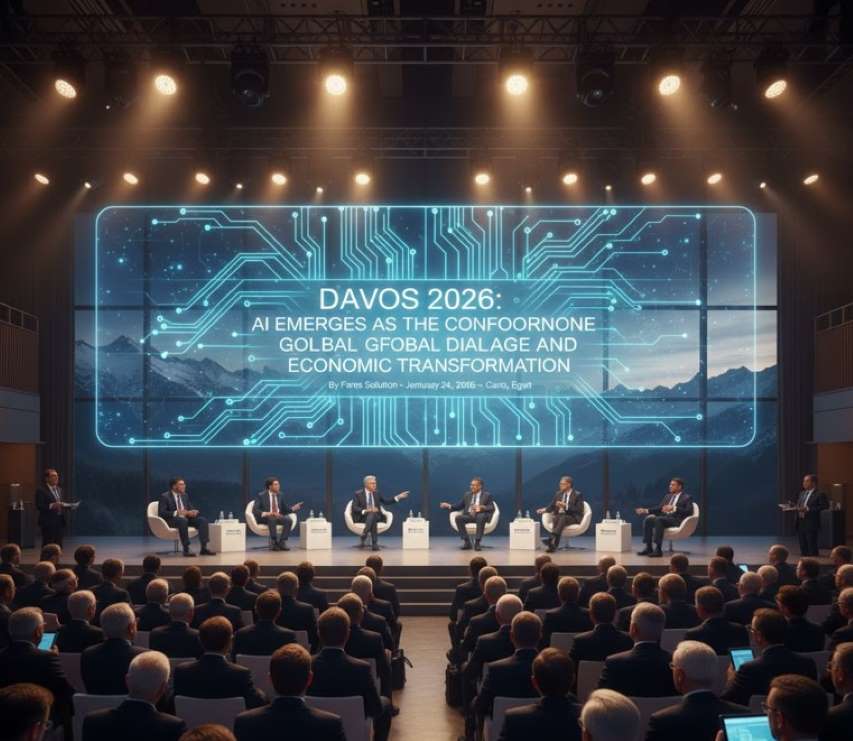
The World Economic Forum Annual Meeting 2026 concluded yesterday in the snow-capped peaks of Davos-Klosters, Switzerland, after five days of intense discussions among over 3,000 leaders from government, business, civil society, and academia. Themed "A Spirit of Dialogue," the event, held from January 19 to 23, 2026, emphasized collective action in an increasingly contested world.
Amid geopolitical tensions, economic uncertainties, and environmental imperatives, one topic dominated the agenda: Artificial Intelligence. From scaling challenges to job creation and the race toward Artificial General Intelligence, the technology was woven into nearly every conversation, signaling its pivotal role in reshaping global priorities.
As the forum wrapped up, attendees left with a mix of optimism and caution. Artificial Intelligence was hailed as a driver of productivity and innovation, yet concerns about its societal impacts—job displacement, ethical dilemmas, and resource demands—loomed large.
Here is a detailed look at how Artificial Intelligence stole the spotlight at Davos 2026.
Artificial Intelligence as the Engine of Growth and Innovation
A recurring theme was unlocking new sources of economic growth through technology. In a session on deploying innovation at scale and responsibly, experts addressed why scaling Artificial Intelligence remains "hard" despite maturing technology. Leaders noted that while adoption is widening, many companies struggle with integration, often redefining entire business models to leverage the systems effectively.
Jensen Huang (Chief Executive Officer of Nvidia), in a high-profile discussion with Larry Fink of BlackRock, described Artificial Intelligence as "core infrastructure" that could boost productivity across industries. Huang emphasized the potential to transform everything from manufacturing to healthcare, predicting a surge in demand for data centers driven by the technology.
A new World Economic Forum report, "From Potential to Performance: How Leading Organizations Are Making Artificial Intelligence Work," released during the meeting, highlighted measurable gains in over 30 countries and 20 industries. The report showcased how the technology is driving efficiency, with examples including predictive maintenance in manufacturing and personalized medicine. However, it stressed the need for responsible deployment to avoid exacerbating inequalities.
Satya Nadella (Chief Executive Officer of Microsoft) echoed this sentiment, urging a shift from "wow demos" to practical applications that deliver real value. He advocated for systems that augment human potential, combining multiple models with agents for tasks like scheduling and forecasting. Nadella’s comments aligned with broader calls for "agentic Artificial Intelligence"—systems where the software acts autonomously, such as in logistics or production.
The Job Debate: Creation vs. Disruption
No discussion at Davos was more animated than the impact of automation on employment. The "jobs, jobs, jobs" mantra dominated panels, with leaders downplaying fears of mass displacement.
Kristalina Georgieva (Managing Director of the International Monetary Fund) warned that 40% of jobs could be transformed or eliminated by Artificial Intelligence, potentially hitting the middle class hardest. Yet, she projected it could add 0.8% to global growth, framing it as a "tsunami" that demands reskilling programs.
Jamie Dimon (Chief Executive Officer of JPMorgan) acknowledged worker impacts but stressed the job-creating potential of the technology.
Alex Karp (Chief Executive Officer of Palantir) predicted specialized roles would be created, reducing reliance on labor immigration.
Union representatives questioned the human cost, citing recent layoffs linked to automation and risks like chatbots leading to mental health issues.
Elon Musk, in a conversation with World Economic Forum President Børge Brende, amplified the discussion by predicting Artificial Intelligence could surpass individual human intelligence by late 2026 or 2027, and all humanity by 2035. Musk highlighted power—not computer chips—as the real bottleneck for scaling, suggesting future data centers could run on solar energy, even from space. He also discussed humanoid robots entering real-world use soon, potentially revolutionizing productivity.
The Race to Artificial General Intelligence and Ethical Concerns
Debates on the timelines for Artificial General Intelligence revealed stark divisions.
Dario Amodei (Chief Executive Officer of Anthropic) compared computer chips designed for Artificial Intelligence to nuclear weapons, warning of job displacement and calling for global governance.
Demis Hassabis (DeepMind) estimated a 50% chance of achieving Artificial General Intelligence within the decade, urging focus on applied uses.
Yann LeCun (Meta) was more skeptical, pushing back on the hype surrounding near-term Artificial General Intelligence.
Yuval Noah Harari (Historian) delivered a stark warning: "Artificial Intelligence is no longer a tool—it is an agent."
In sessions like "An Honest Conversation on Artificial Intelligence and Humanity," speakers explored balancing innovation with human values. Two leading researchers issued overlapping alerts on the pace of development, emphasizing near-future risks.
Energy demands were another flashpoint. Panels noted the shift from hype to production is driving data center expansions and resource needs—some even discussed Greenland for its potential in sustainable energy. Changpeng Zhao (Founder of Binance) highlighted automated agents as autonomous economic actors, using cryptocurrency for transactions.
Sovereign Artificial Intelligence and Infrastructure Bottlenecks
A growing emphasis was placed on "Sovereign Artificial Intelligence"—nations seeking control over data and computing power amid global platforms. This tension could shape regulations and partnerships. Infrastructure emerged as a key constraint: from power generation to standardized Application Programming Interfaces, the focus is shifting to enabling durable systems.
Voice Technology was flagged as underappreciated, especially in emerging markets like India, where it could bypass literacy barriers.
Decentralized Trends, including modular stacks and verifiable models, generated buzz in side events like the Artificial Intelligence House Davos.
Real-Time Reactions and Broader Implications
On the social media platform X (formerly Twitter), Davos 2026 sparked lively discourse. Posts highlighted Musk’s solar-from-space vision and Harari’s warnings regarding agentic systems. One user reflected on the evolution of the forum from quiet talks in 2019 to the ubiquity of the technology in 2026.
Elon Musk ended with a call for optimism:
"For quality of life, it is better to err on the side of being an optimist and be wrong, than a pessimist and be right."
Looking ahead, predictions from Forbes for 2026 align with insights from Davos: every employee with a digital assistant, career shifts toward human-machine teams, and physical pilots in factories. However, risks like deepfakes and agent hijacking underscore the need for robust security.
Davos 2026 reinforced the transformative power of Artificial Intelligence but called for balanced progress. As one attendee noted, in an exponential era, linear thinking risks being left behind. With leaders like Donald Trump, Emmanuel Macron, and Volodymyr Zelenskyy addressing the forum, the message was clear: the technology must serve humanity in a multipolar world. The real test will be translating dialogue into action.
 |  |  |
 |  |  |